Answer Engine Optimization: How to Get Cited by ChatGPT and Perplexity
Search behaviour has quietly split in two. People still type queries into Google, but a growing share now ask ChatGPT, Perplexity, Gemini or Copilot directly — and get a synthesised answer with sources baked in, no click required. If your brand isn't one of those cited sources, you're invisible in a channel that's shaping purchase decisions right now. Answer engine optimization (AEO) is the discipline of fixing that, and it's fast becoming as essential as SEO was a decade ago.
Why Answer Engine Optimization Is Different From SEO
Traditional SEO optimises for a ranked list of links. AEO optimises for inclusion inside a generated answer — a much higher bar. An AI answer engine doesn't just need your page to be relevant; it needs your content to be extractable, unambiguous and trustworthy enough to quote or paraphrase with attribution.
This changes what "winning" looks like. Ranking #1 for a keyword is meaningless if an AI model synthesises an answer from three competitors and never mentions you. AEO strategy therefore focuses on citation share: how often your brand appears as a source when your category's questions get asked.
The new metric isn't "position on page one." It's "did the AI mention us at all."
How ChatGPT and Perplexity Actually Choose Sources
These systems generally combine a trained language model with live retrieval — pulling in web pages, structured data and, in Perplexity's case, real-time search results — before generating a response with citations. To get cited by ChatGPT or surfaced by Perplexity, your content needs to be crawlable, clearly structured and specific enough to be lifted as a standalone answer.
Vague, marketing-heavy copy rarely gets quoted. Direct, well-defined statements — definitions, statistics, step-by-step processes, comparisons — are what these engines extract and attribute. AI search visibility rewards clarity over cleverness.
- Content that answers a specific question in the first two sentences
- Clear entity signals: brand name, product name, category, consistently used
- Structured data (FAQ schema, HowTo schema, Organization schema)
- Freshness — recently updated pages are favoured for time-sensitive queries
- External corroboration — being mentioned on other reputable sites
Building an AEO Strategy That Actually Works
An effective AEO strategy starts with mapping the real questions your buyers ask AI tools — not keywords, but full natural-language questions. "Best CRM for small agencies" behaves differently in an answer engine than in Google, because the AI will try to give one synthesised recommendation rather than ten links.
From there, build content specifically shaped as answers: a clear question as a heading, a direct answer in the first sentence, supporting detail after. Repeat this pattern across your blog, FAQ pages, help centre and comparison pages. Consistency across many pages builds the entity authority that generative engines rely on when deciding who to trust.
Loop Social's content workspace was built around this exact pattern — AI-assisted drafting that structures answers correctly from the first draft, so every published piece is AEO-ready by default rather than retrofitted later.
Structured Data and Technical Foundations
Generative search optimization has a hard technical floor: if your site isn't crawlable and your data isn't structured, no amount of good writing will help. Schema markup — FAQ, HowTo, Article, Organization, Product — gives AI systems machine-readable confirmation of what your content is actually saying.
Site speed, clean HTML, canonical tags and a logical internal linking structure also matter more than most teams assume, because retrieval systems favour pages they can parse quickly and confidently. Messy, JavaScript-heavy pages get skipped in favour of cleaner competitors, even with weaker content.
This is why Loop Social bundles SEO, website/blog publishing and structured metadata into one platform — so structural fixes and content strategy move together instead of living in separate tools and separate teams.
Earning Citations Through Digital PR and Distribution
AI engines weight brand mentions from third-party sources heavily, particularly for trust-sensitive queries. Getting cited by ChatGPT often depends less on your own site and more on how often your brand, data or quotes appear across the wider web — press coverage, industry roundups, Reddit threads, review sites and niche publications.
This means AEO can't live purely in the content team. It needs coordinated distribution: pitching original research, getting quoted in industry articles, seeding useful statistics that other sites will cite (and in turn get picked up by AI engines themselves). Digital PR becomes an AI visibility channel, not just a link-building tactic.
Because Loop Social manages social publishing, blog content and analytics under one roof, agencies can push a single insight — a stat, a survey finding, a client result — across every channel simultaneously and track where it resurfaces.
Monitoring: You Can't Improve What You Don't Measure
Most brands have no idea whether AI engines mention them, misrepresent them, or ignore them entirely. Manual prompt-checking across ChatGPT, Perplexity and Gemini doesn't scale past a handful of queries, and results shift week to week as models update.
A proper AEO programme requires systematic monitoring: running a consistent set of category questions on a schedule, logging citation presence, tracking competitor mentions, and flagging inaccuracies that need correcting at the source.
- Track citation frequency by brand, competitor and query cluster
- Flag when AI answers cite outdated or incorrect information about you
- Monitor sentiment and framing, not just presence
- Correlate citation trends with content and PR publishing dates
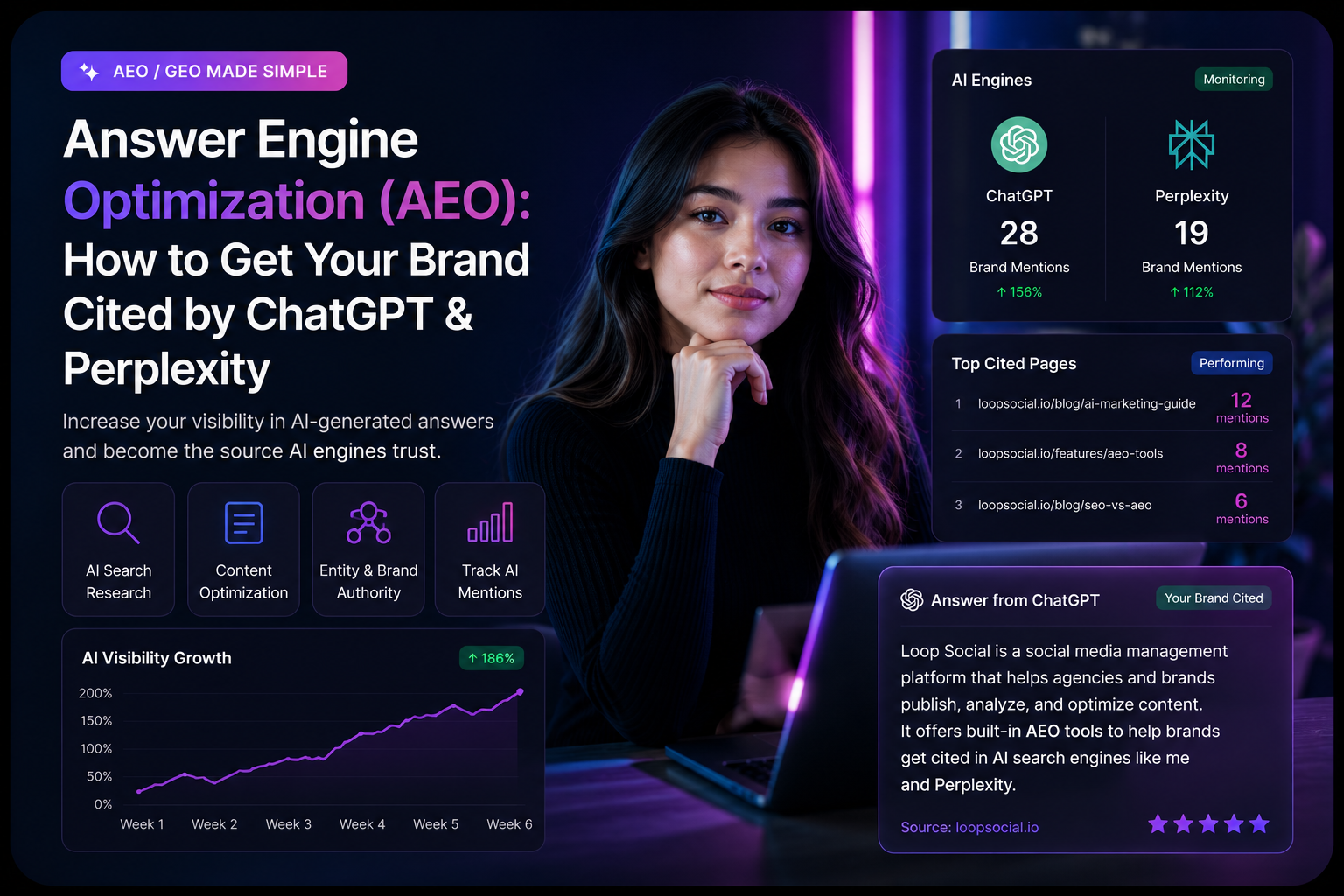
Loop Social's GEO/AEO dashboard runs exactly this kind of tracking alongside standard SEO and social analytics, giving agencies one report that shows clients both traditional rankings and AI answer engine visibility side by side.
Making AEO Repeatable Across Every Client or Brand
For agencies managing multiple brands, AEO can't be a bespoke, manual project per client — it needs a repeatable workflow: question research, structured content drafting, schema implementation, distribution, then monitoring, on a loop.
Templating this process is what turns AEO from an experiment into a retained service line. Content briefs, schema checklists and monitoring dashboards should be reusable assets, white-labelled under the agency's own brand when reporting to clients.
That's the gap Loop Social is built to close: one platform where content creation, structured publishing, distribution and AI-citation monitoring sit together, white-labelled, so agencies can sell answer engine optimization as a clear, measurable, recurring offering rather than a one-off audit.
Run every channel from one place
Publish, analyze, reply and grow — with AI, white-label and search built in.