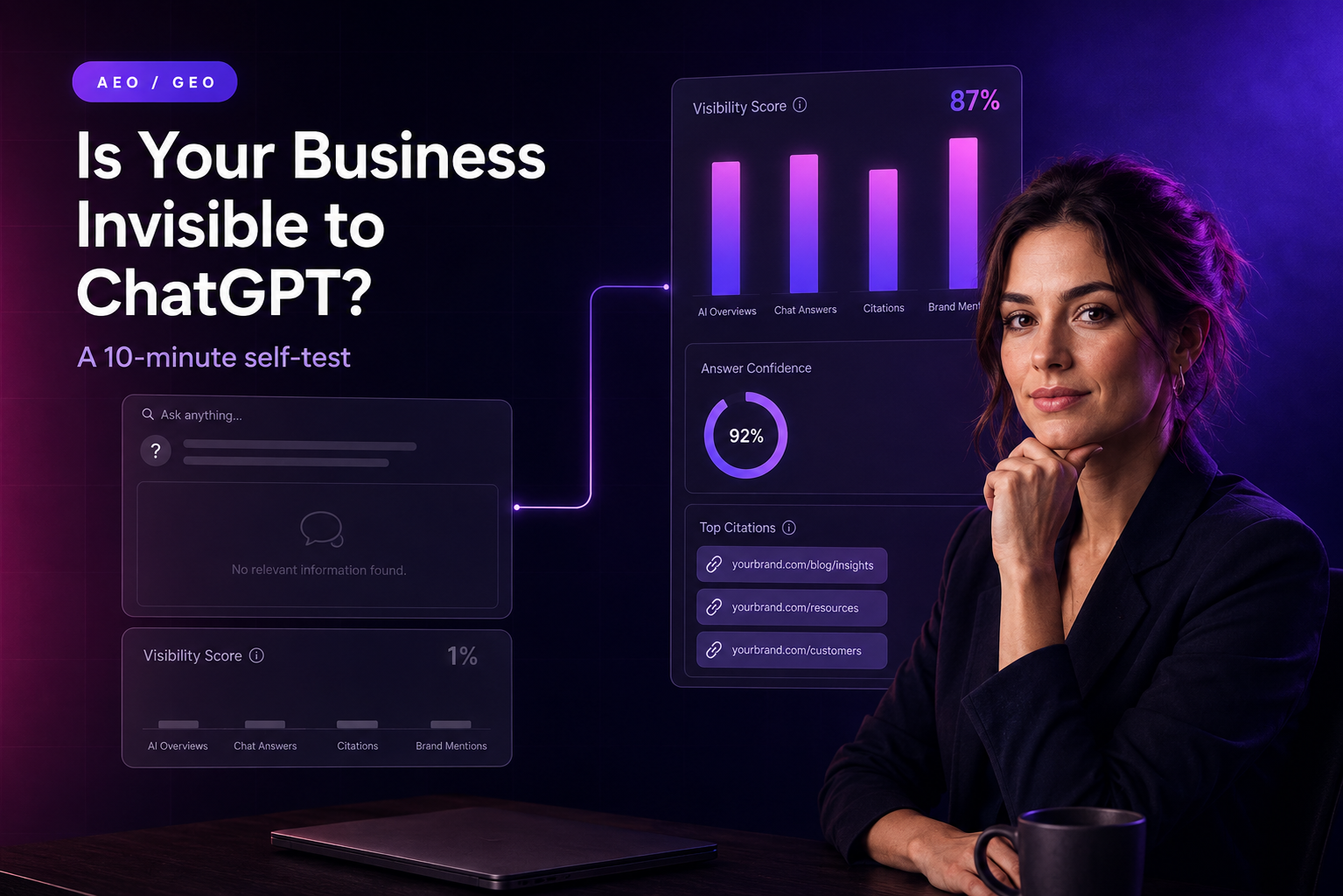
Is Your Business Invisible to ChatGPT? A 10-Minute Self-Test
Every day, millions of people ask ChatGPT, Gemini, and Perplexity questions that used to go straight to Google: "best accountant near me," "top project management tools for agencies," "which skincare brand actually works for sensitive skin." If your business doesn't come up in those answers, you're not losing a little traffic — you're losing the entire conversation. Here's a fast way to find out where you stand, and what to do about it.
Why This Test Matters More Than Your Google Ranking
Search behaviour is splitting. A growing share of buyers now start their research inside a chat interface rather than a search bar, and they often never click through to a website at all. The AI simply gives them an answer, a recommendation, or a shortlist — and if you're not on that list, you don't exist for that customer.
This shift matters because AI answers are curated differently than search rankings. Google shows ten blue links and lets the user judge. ChatGPT picks a handful of options and presents them with confidence, often without disclosing why it chose them. That makes AI visibility a gatekeeping problem, not just a ranking problem.
The 10-Minute Self-Test
Open ChatGPT, Perplexity, and Gemini in separate tabs and run through these prompts. Don't mention your brand name first — ask the way a real customer would.
- Ask a category question with your location: "best [your service] in [your city]"
- Ask a comparison question: "[your category] vs [nearest competitor category]"
- Ask directly: "Tell me about [your business name]"
- Ask a problem-based question your product solves, without naming the solution
- Ask for a shortlist: "top 5 [your industry] providers I should consider"
Score yourself: does your business appear unprompted? Is the description accurate? Are your differentiators mentioned, or does the AI default to generic filler? If you scored zero or one out of five, you have a visibility problem worth solving urgently.
Why AI Models Skip Perfectly Good Businesses
AI assistants build their answers from a blend of training data and live retrieval — structured content, review sites, Wikipedia-style sources, forums, and well-cited web pages. Businesses that rely purely on a polished homepage and paid ads are frequently invisible here, because that content isn't structured or referenced in the way these models trust.
Common gaps include thin or inconsistent business information across the web, a lack of clear factual statements the AI can quote, weak or absent third-party citations, and no schema markup to help machines understand what you actually do. None of these are visible problems to a human visiting your site — but they're exactly what an AI model is scanning for.
An AI model doesn't rank you. It decides whether it trusts you enough to mention you at all.
What "Good" Looks Like in AI Answers
Businesses that show up consistently tend to share a few traits: clear, factual, quotable statements about what they do and who they serve; consistent business details (name, service, location, credentials) repeated across many independent sources; and active presence in places AI models pull from — review platforms, industry directories, comparison articles, and Q&A content.
They also tend to publish content structured around real questions, not just marketing copy. Pages titled around what people actually ask — "how much does X cost," "is X worth it," "X vs Y" — perform far better in AI answers than generic service pages, because they match the exact shape of the query a user typed into the chatbot.
Turning the Test Into an Action Plan
Once you know your gaps, the fix is methodical, not mysterious. Start by auditing what's currently said about your business across the web — directories, review sites, press mentions, forums — and correct anything inconsistent or outdated. Then build out content specifically answering the questions your ideal customers are asking AI, using clear, factual language the model can lift directly.
From there, focus on earning citations: guest content, digital PR, structured data on your site, and active review management all feed the sources these models trust. This isn't a one-off project — AI models refresh and re-crawl constantly, so ongoing monitoring and publishing is what keeps you visible rather than a single burst of activity.
Where Loop Social Fits In
Running this audit manually across multiple AI models, tracking mention frequency over time, and coordinating the content fixes across SEO, GEO, and website teams is exactly the kind of fragmented workflow that causes businesses to give up. Loop Social was built to remove that friction by bringing GEO/AEO monitoring into the same platform as your social, SEO, website, and Google Business management.
Inside the dashboard, you can track how often and how accurately your brand appears across ChatGPT-style answers, generate the structured, question-led content that AI models prefer to cite, and push consistent business information across your website and listings — all without switching tools. For agencies, the entire suite is white-label, so you can offer AI visibility audits and ongoing GEO management as a branded service to your own clients.
The Cost of Waiting
Every month you're invisible to AI is a month your competitors have to establish themselves as the "default answer" for your category. Once an AI model settles into a habit of recommending certain brands for a given query, that pattern tends to persist — making early movers disproportionately rewarded.
The self-test above takes ten minutes. Fixing what it reveals takes longer, but not as long as most businesses assume — especially with a platform built to handle monitoring, content generation, and publishing in one connected system rather than five disconnected tools.
Run every channel from one place
Publish, analyze, reply and grow — with AI, white-label and search built in.