

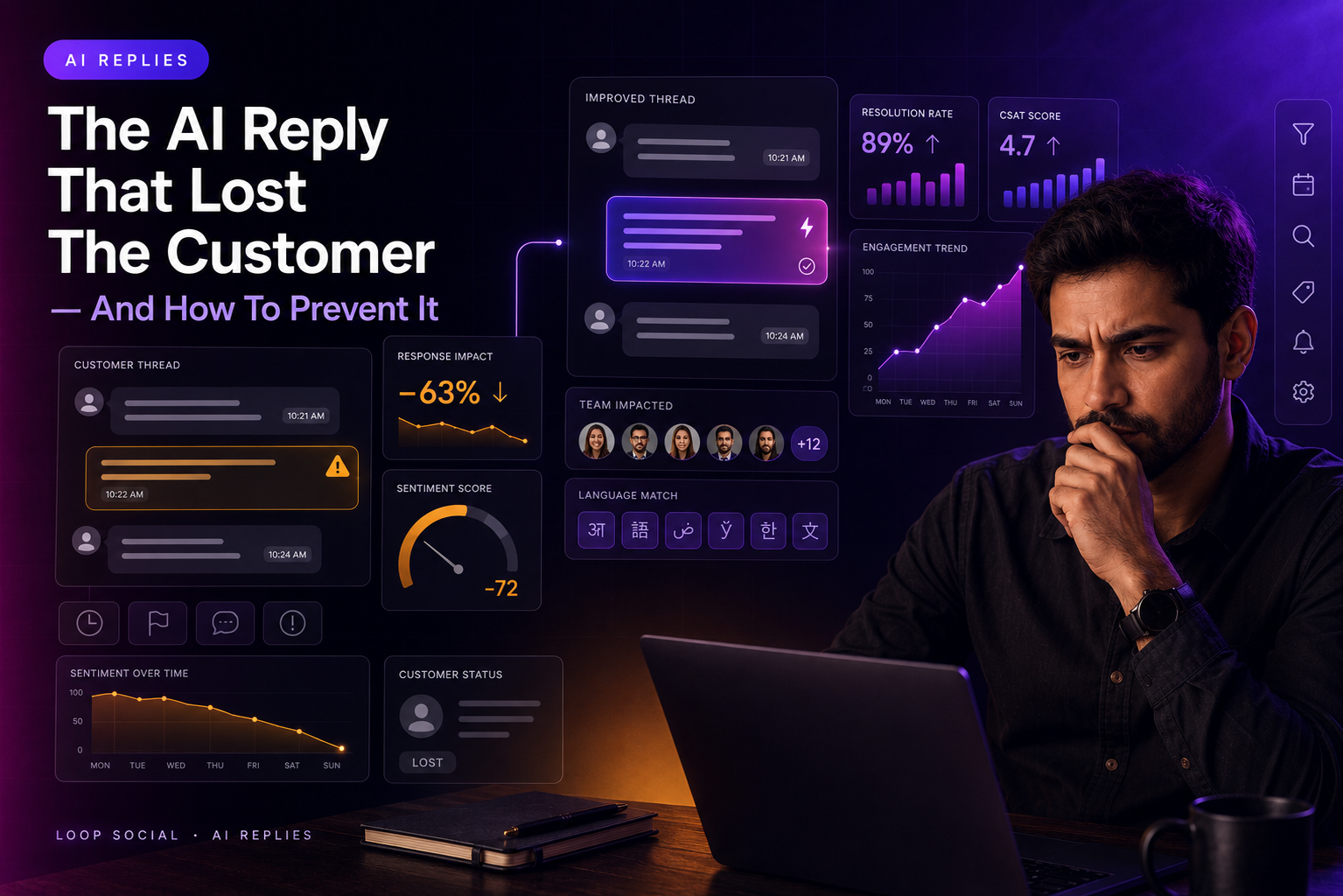
The AI Reply That Lost The Customer — And How To Prevent It
It starts small. A customer complains publicly about a late delivery. An AI tool fires back a cheerful, generic reply — "We're sorry to hear that! We value you as a customer! 😊" — completely missing that the order was a birthday gift that arrived a week late. The customer doesn't reply. They don't need to. They've already decided. That single tone-deaf message, sent in under two seconds by a well-meaning automation, undid months of loyalty. This is the quiet risk sitting inside every AI reply tool that wasn't built with guardrails.
Why the fastest reply isn't always the right one
Speed has become the default metric for customer service success, and AI has made near-instant responses possible at scale. But speed without context is just noise delivered quickly. An AI model trained on generic internet text has no idea that this particular customer is a VIP, that this particular complaint references a refund promised last week, or that this brand's voice is dry and witty rather than exclamation-mark cheerful.
The result is a reply that is technically responsive but emotionally wrong. For a single brand, that's a bad look. For an agency managing dozens of client accounts, it's a systemic exposure — one misfire multiplied across every account running the same ungoverned AI settings.
The hidden cost multiplies for agencies
Agencies don't just risk one client relationship when an AI reply goes wrong — they risk their own reputation as the trusted operator behind the account. A client who sees a screenshot of an off-brand or insensitive AI reply won't ask "which AI vendor did this?" They'll ask "why is my agency letting a robot talk to my customers without checking?"
The mistake isn't using AI for replies. The mistake is letting AI reply without a brand-aware filter and a human checkpoint.
This is precisely why Loop Social was built as a platform layer around AI, not a raw AI plug-in. Every reply suggestion passes through brand context, sentiment scoring and configurable approval rules before it ever reaches a customer.
What a safe AI reply workflow actually looks like
Inside Loop Social, AI drafting and AI sending are deliberately separate steps. The platform pulls in the comment or review, checks sentiment and urgency, drafts a response using the brand's trained voice profile, and then places it in a queue for a human to approve, edit or reject — unless the team has explicitly whitelisted that scenario for auto-send.
- Brand voice profiles built from each client's historical posts, replies and tone guidelines
- Sentiment and urgency flags that route angry or high-stakes messages straight to a human
- Grounded responses that reference real order, CRM or FAQ data instead of guessing
- One-click edit-and-send so approval takes seconds, not minutes
- Full audit history showing who approved what, and when
This structure keeps the speed benefit of AI while removing the blind-trust risk. The AI does the heavy lifting of drafting; the human keeps the judgement.
Turning sentiment into a routing decision, not a guess
Not every comment carries the same risk. A question about opening hours is low-stakes and can safely auto-reply. A complaint referencing a refund, a safety issue, or public frustration is high-stakes and needs eyes on it before anything goes out. Loop Social's unified inbox scores incoming messages by sentiment and flags anything negative or ambiguous for priority human review, while routine, positive or neutral messages can move through a faster, lighter-touch path.
This tiered approach means teams aren't drowning in low-value approvals, but they're never blindsided by a high-risk reply slipping through on autopilot. It's the difference between AI as a filter and AI as a gamble.
Consistency across every client, without losing personality
For agencies running white-labelled AI reply management across many accounts, consistency is the real challenge. A fashion brand's voice shouldn't sound like a B2B software client's voice, and neither should sound like a template. Loop Social keeps brand voice profiles isolated per client, so the AI draft for one account never bleeds tone or phrasing into another.
Because the whole system sits under the agency's own branding, clients see a polished, consistent, on-voice reply experience — never a hint that a shared AI engine is running underneath. That distinction matters commercially: it's what lets agencies charge for judgement and process, not just for access to a chatbot.
Making the AI reply a loyalty moment, not a liability
Done well, an AI-assisted reply can actually strengthen a relationship rather than risk it. A fast, accurate, correctly-toned response to a public complaint — visible to every other customer watching that thread — signals a brand that listens and acts. Loop Social's CRM integration means the drafted reply can reference the customer's actual history, making even an AI-assisted first draft feel personal rather than templated.
The goal isn't to slow AI down for the sake of caution. It's to give every reply the context and checkpoint it needs to land the way it was intended — fast where speed is safe, careful where care is required, and always recognisably the brand's own voice.
Rolling this out without slowing your team down
Teams worried that adding approval steps will create bottlenecks usually find the opposite once brand voice profiles are trained properly: most drafts need zero edits, approval becomes a glance-and-click action, and the time saved on drafting far outweighs the seconds spent reviewing. Loop Social lets agencies set the exact balance of automation and oversight per client, per channel and per message type, so the workflow scales without ever removing the human decision at the moment it matters most.
The AI reply that lost the customer is almost always a story about missing context, not bad technology. Give the AI the right guardrails, and it becomes the fastest way to keep a customer — not the fastest way to lose one.
Run every channel from one place
Publish, analyze, reply and grow — with AI, white-label and search built in.